What to Do After Slipping on Ice Outside an Erie Business
One moment you are walking into a store on Peach Street or crossing a parking lot in Millcreek, and the next you are on the ground. Erie winters make that moment common: lake-effect snow, a midday thaw, and an overnight refreeze can turn a business’s sidewalk into a sheet of clear ice by morning. What you do in the first hour — and first few days — after that fall decides a great deal about your recovery and any claim.
This guide walks through what to do after slipping on ice outside an Erie business: the medical care to get first, how to report the fall, the photographs that matter most because ice evidence literally melts, and how Pennsylvania law — including the special rule courts apply to snow and ice — decides who pays. It is general information only. Our Erie snow and ice slip and fall lawyers explain the same ground in a free consultation.
First: Get Medical Care — Falls on Ice Hit Wrists, Hips, and Heads
Get checked the same day, even if you got up and walked away. Falls on ice produce a recognizable set of injuries: a wrist fractured when you throw a hand out to catch yourself, a hip or pelvis injury when you land on your side, a back injury from the twisting impact, and head injuries — including concussions — when the ice gives you no chance to break the fall. Some worsen quietly: a hip injury that feels like a bruise can be a fracture; a headache that seems minor can be a concussion’s first sign. Urgent care, your own doctor, or an emergency department such as UPMC Hamot or AHN Saint Vincent can rule out the serious versions, and MedlinePlus’s falls guidance makes the same point: get evaluated, and watch for delayed symptoms.
Tell the provider exactly how it happened — that you slipped on ice outside a named business, where, and at what time. That first note becomes the record connecting your injuries to that patch of ice, written before anyone has reason to dispute it. Follow up as directed, report new pain, numbness, dizziness, or swelling promptly, and keep every bill and record — if a claim follows, the medical file is its backbone.
One practical point: keep the shoes or boots you were wearing. In ice cases the defense almost always argues the footwear was the problem; the tread on those boots is evidence, and it answers the argument better than any description.
Report the Fall to the Business Before You Leave, If You Can
If you are able, tell the business what happened before you leave — a manager, not just the nearest employee — and ask that an incident report be made. Give the basic facts: where you fell, when, and that ice was involved. Ask for a copy of the report, or at least the manager’s name and the report number; if none is offered, write down the name of everyone you spoke with.
Reporting does two things. It fixes the time and place of the fall in the business’s own records, which matters when an insurer later suggests the fall happened somewhere else. And it starts the clock on evidence the business controls: entrance camera footage is routinely overwritten within days or weeks, and a prompt report — and later a lawyer’s preservation letter — is often the difference between that video existing and not existing.
Be accurate and brief. Do not speculate about fault, do not say you are ‘fine’ if you are hurt, and do not sign anything beyond acknowledging the report itself. If you need to leave, report by phone the same day.
GET A FREE CONSULTATION.
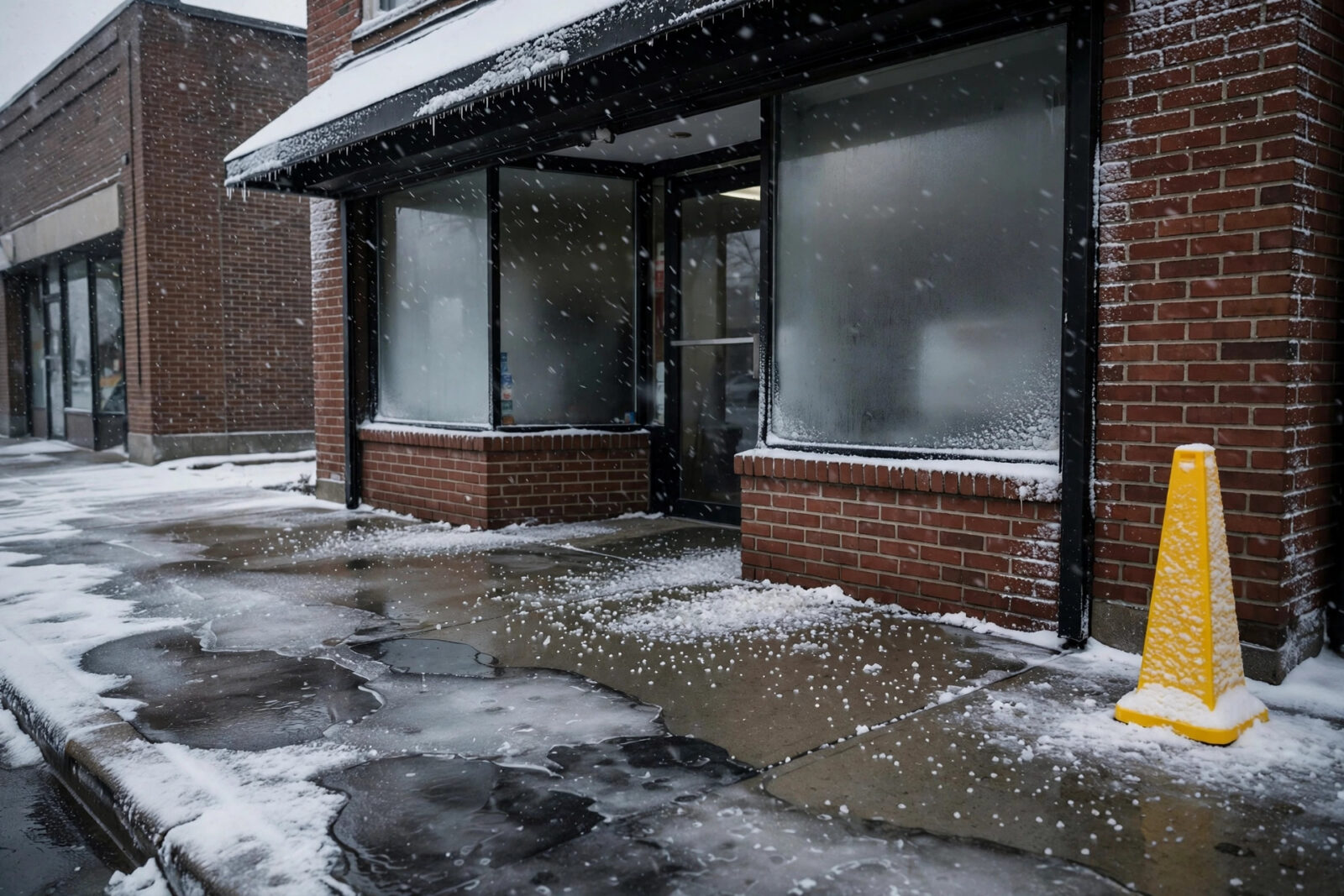
Photograph the Ice Before It Melts, Gets Salted, or Is Cleared
In most injury cases, evidence waits. In an ice case, it evaporates — sometimes within the hour, when an employee throws salt or a plow passes. Same-day photographs are frequently the most important evidence in the claim, because by the time an insurer investigates, the condition that caused the fall is gone.
Photograph or video the following, or ask a family member to go back the same day:
- The exact spot — close-ups showing the ice’s texture and whether it is smooth sheet ice or rough, ridged accumulation.
- The wider scene — the entrance, sidewalk, or lot from several angles, showing how a customer would approach and whether any route avoided the ice.
- Drainage clues — downspouts, dripping awnings, sloped pavement, or puddle edges that show where meltwater runs and refreezes.
- What the business did or did not do — salt or grit present or absent, cones or signs, handrails, and neighboring stretches of walkway for comparison.
- Your injuries and clothing — bruising as it develops over the following days, and what you landed in.
Note the weather as well: what the National Weather Service reported for Erie that day — when snow fell and whether temperatures crossed freezing. Those records are objective, they are kept, and they let a lawyer reconstruct the freeze-and-thaw timeline the legal analysis below turns on.
Why Erie Winters Make These Falls So Common
Erie sits in the Lake Erie snowbelt, and the National Weather Service office in Cleveland — which covers Erie County — warns about the pattern every winter: lake-effect bands can drop heavy snow on one neighborhood while the next stays nearly clear, and temperatures hovering around freezing produce repeated melt-and-refreeze cycles. The most dangerous surface is often not deep snow, which gets cleared, but black ice — meltwater that refreezes overnight into a nearly invisible sheet.
That pattern shapes the legal questions, too. A business is not expected to keep its walks bare during an active lake-effect storm. But Erie businesses also know — because it happens every winter — that a thawed afternoon means an icy entrance the next morning, and that entrances, downspout discharge points, and low spots refreeze first. When a fall happens, the argument is usually about that gap: what the business knew about its own problem spots, and what it did between the storm and the moment you fell.
Who Is Responsible When You Slip on Ice Outside a Business?
Pennsylvania premises liability law starts with your status. A customer entering a business open to the public is an invitee — the category owed the highest duty of care. The business must keep its premises reasonably safe, correct hazards it knows about, and warn of hazards reasonable inspection should have discovered. Our Erie slip and fall lawyers work through that framework on the firm’s practice page; in an ice case, it produces three practical questions.
First, how long was the ice there? Ice that formed twenty minutes before your fall, during an ongoing storm, is a different case from ice left untreated through a full business day after the storm ended. Second, did the business know, or should it have known — from employees using the same entrance, prior complaints, or a known refreezing spot? Third, what did the business do — salting, clearing, treating known drainage problems, warning customers — and can it document any of it? Maintenance and salting logs, or their absence, are often decisive.
Responsibility can also be shared. A tenant business, the landlord, and a snow-removal contractor can each bear part of the duty depending on the lease and the service contract — which is why early investigation matters: the contracts decide who owed what. Expect the defense to raise your own conduct as well. Under Pennsylvania’s comparative negligence rule, 42 Pa.C.S. § 7102, your compensation is reduced by your share of fault, and you recover nothing if you are found more than 51 percent at fault. Claims that the ice was open and obvious are the standard version of that argument.
GET A FREE CONSULTATION.
The Hills and Ridges Doctrine: Pennsylvania’s Special Rule for Snow and Ice
Pennsylvania courts apply a doctrine to snow-and-ice falls found in few other premises cases: the hills and ridges doctrine. A property owner is not liable merely because its sidewalk or lot was generally slippery after a storm. To recover, an injured person ordinarily must show that snow or ice had accumulated in hills, ridges, or elevations that obstructed travel and were a danger, that the owner had notice, and that the accumulation — not just general slipperiness — caused the fall. Pennsylvania appellate courts have applied this framework for decades; their published opinions are available through the Unified Judicial System at pacourts.us.
The doctrine exists for a practical reason: in a Pennsylvania winter, keeping every surface completely clear of ice at all times would be impossible. But it has real limits, and they are where most Erie ice cases are decided. It addresses naturally accumulated snow and ice — it does not protect an owner whose drainage design, leaking downspout, or plowed snowbank creates a melt-and-refreeze hazard in the same spot all winter, and it does not excuse an owner who had notice of dangerous ridges and did nothing for days.
This is why the photographs and the weather timeline matter so much. Whether the surface was a smooth sheet or a rough, ridged accumulation; whether the ice came from the storm or from the downspout by the door; how many freeze-and-thaw cycles passed before your fall — those facts place the case inside or outside the doctrine, and they disappear first.
What About the Sidewalk Itself — and Falls on Public Property?
Many Erie falls happen on the sidewalk in front of a business rather than on its lot. In Pennsylvania, the duty to maintain a sidewalk generally rests first with the owner of the property abutting it, and municipalities commonly reinforce that duty by ordinance, requiring the abutting owner or occupant to clear snow and ice. So a fall on an uncleared sidewalk outside a shop is usually analyzed against the business or property owner first — not the city.
Claims against a government body are the exception, on stricter rules. Where a fall involves property owned by a city, county, or the Commonwealth — a public building’s steps, a government lot — the Political Subdivision Tort Claims Act limits when suit is possible at all, and 42 Pa.C.S. § 5522 generally requires written notice to the agency within six months of the injury. Miss that notice and the claim can be lost regardless of the two-year deadline below.
What an Ice Fall Claim Can Cover
A successful claim compensates the losses the fall caused: medical expenses — emergency care, imaging, surgery, physical therapy, and follow-up care; lost income, including the winter-season hours hourly and seasonal workers lose while a wrist or hip heals; and the non-economic side — pain, limitations on daily activities, and lasting stiffness or scarring. Where an injury permanently limits your work, future earning capacity can be part of the claim as well.
Two cautions belong here. An insurer’s early offer — often framed as paying your medical bills if you sign a release — prices the claim before treatment is finished and before anyone knows whether the injury is the lasting kind; the release, not the check, is the point of that transaction. And your own health insurance may claim repayment from any recovery. Both are reasons to understand the full picture before agreeing to any number.
Deadlines and Mistakes That Can Hurt an Erie Ice Fall Claim
Pennsylvania’s statute of limitations for personal injury, 42 Pa.C.S. § 5524, generally gives you two years from the date of the fall to file a lawsuit. Miss it and the claim is barred, however clear the ice was. Two qualifications matter: the six-month government notice described above runs far sooner where it applies; and ice-case evidence degrades in days — camera footage is overwritten, salting logs are lost, and the surface changes with the next thaw. Treat two years as an outer limit, not a timeline.
The mistakes that most often damage valid claims are quiet ones: waiting to get medical care, which lets the insurer argue the fall was trivial; never reporting the fall; failing to photograph the ice before it was treated or melted, which hands the hills and ridges argument to the defense; and giving a recorded statement while still being treated, locking in an incomplete account of your injuries. Each is avoidable, and avoiding them costs nothing.
When to Talk to an Erie Slip and Fall Lawyer
Not every slip needs a lawyer. But get advice before dealing with an insurer further if: you broke a bone, hit your head, or needed surgery or hospital care; you have missed work; the business or its insurer disputes that the ice was there or blames you; the fall happened on or near public property, where the six-month notice may be running; or an adjuster is pressing for a statement or a release. In ice cases, the early investigation — photographs, weather records, camera footage, maintenance logs — is the case, and it cannot be reconstructed later.
At Purchase, George & Murphey, P.C., our Erie snow and ice accident attorneys evaluate who owed the duty for the surface you fell on, whether the hills and ridges doctrine actually applies, and every policy that might respond — and deal with the insurer so you do not have to. Consultations are free, and injury cases are handled on a contingency basis — you pay no fee unless there is a recovery. In a case built on melting evidence, that conversation is worth having early.
GET A FREE CONSULTATION.
About Purchase, George & Murphey, P.C.
Notable Results
- $4,500,000 — Medical malpractice, wrongful death and survival actions (attorney: Eric Purchase).
- $1,250,000 verdict — McKean County car accident: a young woman’s vehicle collided with a truck at approximately 50 mph; she suffered multiple injuries.
- $700,000 settlement — Motorcycle fatality: the underinsured motorist carrier, which had originally denied the claim, paid the policy limits.
- $545,000 settlement — Car accident: an oncoming SUV slid across the roadway after a snowstorm into a head-on collision.
- $500,000 — Pedestrian struck by car.
- $325,000 settlement — From zero to $325,000 in six months.
Prior results do not guarantee a similar outcome. Each case is different and must be evaluated on its own facts.
What Clients Say on Google
“I can’t thank Mr Purchase and his team enough for everything they did for me!”
— Vicky
“Eric guided me through all of my options and gave his very honest and thorough opinion on each.”
— Hali
“I would highly recommend Attorney Eric Purchase and this law firm”
— Bruce
Professional Recognition
- Eric J. Purchase — Pennsylvania Super Lawyers (2013–2022); President’s Award, Erie County Bar Association (2015); past president, Erie County Bar Association (2018) and Western Pennsylvania Trial Lawyers Association (2020–2021).
- Tim George — AV-Preeminent® rated by Martindale-Hubbell; rated 10/10 by Avvo; Pennsylvania Super Lawyers, criminal defense (2016–2022); President, Erie County Bar Association (2023).
- Craig Murphey — selected for inclusion in The Best Lawyers in America every year since 2012; Best Lawyers “Lawyer of the Year,” Pittsburgh region, for Personal Injury–Defense (2017) and Insurance Law (2019); Pennsylvania Super Lawyer every year since 2011.
Related Articles
- How to Win A Slip and Fall Accident Claim on Wet Floor
- How to File a Claim for Slip and Fall Stairway Injuries
- Can I Sue My Landlord?
- What NOT to Do When You’re Injured
- How Much is My Personal Injury Claim Worth in Pennsylvania?
- Should I Give a Recorded Statement to the Insurance Company?
Published Articles by PGM Attorneys
- Warm Weather, Higher Stakes: Why Spring Driving Habits Put Pedestrians and Cyclists at Risk — Eric J. Purchase, The Legal Intelligencer / Law.com, June 4, 2026.
- ‘I Only Looked Down for a Second’ Is Not a Legal Defense — Eric J. Purchase, The Legal Intelligencer / Law.com, April 23, 2026.
- Letter to the editor: Serpentine Drive was always for more than pedestrians — Eric J. Purchase, Pittsburgh Post-Gazette, June 24, 2026.
Frequently Asked Questions About Ice Slip and Fall Accidents in Erie, Pennsylvania
The answers below address the questions we hear most often after a winter ice fall in Erie and Erie County. They summarize Pennsylvania law in general terms; for advice about your own fall, a free consultation is the next step.
Should I see a doctor even if I feel okay after slipping on ice?
Yes. Falls on ice commonly cause wrist and hip fractures and head injuries, and some of the most serious versions — a hairline hip fracture, a concussion — can feel minor in the first hours. MedlinePlus’s falls guidance stresses prompt evaluation and watching for delayed symptoms.
Prompt care also protects the claim: the first medical note records that you slipped on ice at a specific place and time, and gaps between a fall and treatment are the first thing an insurer uses to argue the injury was trivial or unrelated.
Sources: MedlinePlus: Falls; CDC: Facts About Falls
What should I photograph after slipping on ice outside a business?
Photograph the ice itself — close-ups showing whether it is smooth sheet ice or rough, ridged accumulation — and the wider entrance, sidewalk, or lot from several angles. Capture drainage clues such as downspouts and dripping awnings, and whether salt, cones, or warning signs were present or absent.
Do it the same day, or send someone back. Ice evidence melts, gets salted, or is plowed away, and by the time an insurer investigates, the condition is usually gone. Also save the National Weather Service’s record of that day’s Erie weather — snowfall and freeze-and-thaw timing are objective and kept.
Sources: National Weather Service: Winter Safety; NWS Cleveland (covers Erie County)
Is a business responsible for ice on its sidewalk or parking lot in Pennsylvania?
It can be. A customer is an invitee, owed the highest duty of care: the business must correct hazards it knows about and warn of hazards reasonable inspection should have found. For sidewalks, the duty generally rests first with the owner of the property abutting the walk.
The answer turns on how long the ice was there, whether the business knew or should have known, and what it did — salting, clearing, treating a known refreeze spot.
Sources: Cornell LII: Invitee; Cornell LII: Negligence
What is the hills and ridges doctrine I keep hearing about?
It is a Pennsylvania rule specific to snow and ice. An owner is generally not liable merely because a surface was slippery after a storm; the injured person ordinarily must show the snow or ice had built up in hills, ridges, or elevations that obstructed travel, that the owner had notice, and that the accumulation caused the fall.
The doctrine has limits: it does not protect an owner whose downspout, drainage, or plowed snowbank creates a recurring melt-and-refreeze hazard, and it does not excuse days of inaction after notice.
Sources: Hung v. Parkway Corp., No. 3728 EDA 2016 (Pa. Super. Ct. 2018) — hills and ridges doctrine (pacourts.us); Cornell LII: Negligence
Does the hills and ridges doctrine apply to black ice from a leaking downspout?
Generally, no — or at least not in the same way. The doctrine was developed for generally slippery conditions from natural storm accumulation. A localized patch of ice created by a property’s own drainage — a downspout discharging across a walkway, a leaking gutter, meltwater from a plowed pile — is a specific, recurring hazard the owner can be expected to know about and fix.
That distinction is often where Erie ice cases are decided, because freeze-and-thaw cycles make refreeze spots predictable. Photographs showing the ice’s source, and evidence the spot froze repeatedly, are the proof that matters.
Sources: Heiser v. Little Enterprises, No. 440 WDA 2019 (Pa. Super. Ct. 2019) — hills and ridges and natural accumulation (pacourts.us); National Weather Service: Cold Weather Safety
What if the business says the storm was still going on when I fell?
That is a real defense, within limits. Pennsylvania law does not expect an owner to keep walks completely clear during an active storm, and ice that formed minutes before a fall, mid-storm, is hard to hold a business responsible for. But the defense ends with the storm: once snow stops, a reasonable time to treat known hazards begins.
The timeline is provable: National Weather Service records show when Erie’s snow fell and when temperatures crossed freezing, and your photographs and the incident report fix when you fell.
Sources: National Weather Service: Winter Safety; NWS Cleveland (covers Erie County)
What if I fell on a city sidewalk or other public property in Erie?
Start with the abutting property owner: sidewalk maintenance generally falls first on the owner of the property the walk abuts. Most falls outside a business are analyzed against the business or landlord, not the city.
If a government body is genuinely responsible — a public building’s steps or lot — stricter rules apply, including Tort Claims Act limits and, under 42 Pa.C.S. § 5522, written notice to the agency generally within six months.
Sources: 42 Pa.C.S. Chapter 55 — Limitation of Actions; Erie County Courts of Common Pleas (pacourts.us)
Can I still recover if the insurer says the ice was obvious and I should have avoided it?
Usually, yes — obviousness is an argument, not an automatic bar. Pennsylvania follows comparative negligence: compensation is reduced by your share of fault, and you recover nothing only if you are found more than 51 percent at fault. Customers are entitled to use a business’s entrance, and an ‘obvious’ patch at a doorway customers must cross is weighed differently from a shortcut across an untreated lot.
What you were wearing, whether a safer route existed, and whether the business warned anyone all feed the comparison. An adjuster’s early percentage is an opening position, not a finding.
Sources: Cornell LII: Comparative Negligence; 42 Pa.C.S. Chapter 71 — Comparative Negligence
How long do I have to file a slip and fall lawsuit in Pennsylvania?
Generally two years from the date of the fall, under Pennsylvania’s personal injury statute of limitations, 42 Pa.C.S. § 5524. A suit filed after that date is ordinarily barred, however clear the ice or serious the injury.
Do not treat two years as working time. If a government body may be involved, a six-month written notice can apply, and ice-case evidence — camera footage, salting logs, the surface itself — disappears in days or weeks.
Sources: 42 Pa.C.S. Chapter 55 — Limitation of Actions; Cornell LII: Statute of Limitations
Whose insurance pays for an ice slip and fall claim, and what can it cover?
Usually the business’s or property owner’s commercial liability policy, handled by an adjuster. The Pennsylvania Insurance Department publishes consumer information about insurance claims and complaints. A claim can cover medical expenses, lost income, and pain and lasting limitations.
Be careful with early offers that pay medical bills in exchange for a signed release: the release surrenders the wage and pain claims before treatment is finished. Your own health insurer may also claim repayment from a recovery — one more reason to value the whole claim before signing.
Sources: Pennsylvania Insurance Department; Cornell LII: Damages