A car accident in Erie can turn an ordinary drive — down Peach Street, across the Bayfront Parkway, or onto I-90 in lake-effect snow — into a tangle of medical bills, missed work, and insurance phone calls. What you do in the first hours and days matters more than most people realize. Pennsylvania’s insurance rules are unlike most states, and a few early mistakes can quietly limit what you are able to recover later.
This guide walks through the steps that protect your health and your claim after a crash in Erie, Pennsylvania: getting safe and getting help, documenting the scene, obtaining the police report, and understanding how Pennsylvania’s choice no-fault system, first-party medical benefits, and two-year filing deadline actually work. If another driver’s carelessness caused your injuries, our Erie car accident lawyers can review what happened in a free consultation.
Step 1: Get Safe, Check for Injuries, and Call 911
Your first job is safety, not paperwork. Check yourself and your passengers for injuries. If anyone is hurt, call 911 and wait for emergency responders. Erie Fire Department paramedics and ambulance crews respond to serious crashes across the city, and Pennsylvania State Police troopers from Troop E handle many crashes on I-79, I-90, and state routes in Erie County.
If the vehicles can be moved safely and no one is seriously hurt, move them out of the travel lanes — onto a shoulder, a side street, or a parking lot — and switch on your hazard lights. Erie drivers know how fast a stopped car on the Bayfront Connector or West 12th Street becomes the cause of a second crash, especially in rain or snow. If a car cannot be moved, or someone is injured, leave everything where it is and get yourself to a safe spot away from traffic.
Pennsylvania law requires drivers involved in a crash to stop, stay at the scene, and exchange information. Under the Vehicle Code, you must give your name, address, vehicle registration, and insurance information to the other driver and to any investigating officer, and you must render reasonable assistance to anyone injured. Leaving the scene of a crash involving injury or death is a criminal offense, not a shortcut.
Step 2: Get Medical Care Promptly — Even If You Feel “Fine”
Adrenaline hides injuries. Whiplash, concussions, and internal injuries often do not announce themselves at the scene; they show up that night or two days later. Get checked the same day if you can — at an emergency department such as UPMC Hamot or AHN Saint Vincent in Erie, an urgent care clinic, or your own doctor’s office — and tell the provider clearly that you were in a car accident, when it happened, and every place you hurt.
Prompt care protects you twice. First, it catches injuries while they are most treatable. Second, it creates a medical record that ties your injuries to the crash date. When people wait a week to see a doctor, insurance adjusters argue the injury came from something else. Follow the treatment plan, keep every appointment, and save every bill, prescription receipt, and discharge paper — those records become the backbone of any claim.
One Pennsylvania-specific point surprises many people: your own auto insurance usually pays your first medical bills after a crash, no matter who caused it. That coverage — first-party medical benefits — is explained in Step 5 below. Tell the hospital or clinic to bill your auto insurer first, and open that claim with your own carrier right away.
GET A FREE CONSULTATION.
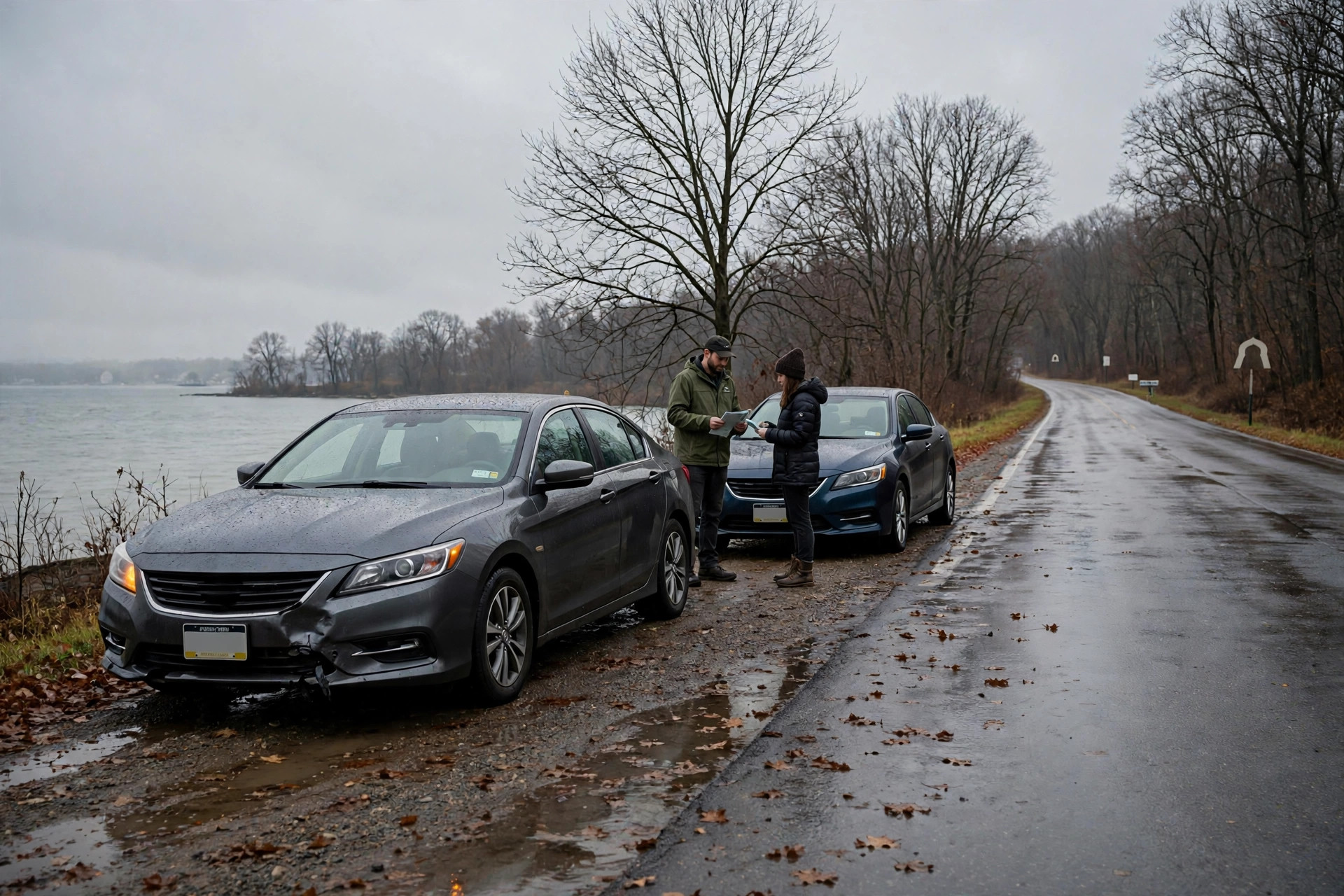
Step 3: Document the Scene Before the Evidence Disappears
Crash scenes in Erie get cleaned up fast, and winter weather erases skid marks and debris within hours. While you wait for police — and only if it is safe — use your phone to build the record an insurer cannot argue with later:
- Photograph everything: all vehicles from several angles, close-ups of the damage, license plates, the intersection or roadway, traffic lights and stop signs, skid marks, debris, road conditions (ice, standing water, potholes, faded lane markings), and any visible injuries.
- Capture the setting: a wide shot showing where each vehicle came to rest, nearby businesses that may have security cameras, and the weather and lighting at the time.
- Exchange complete information: the other driver’s name, address, phone number, driver’s license number, license plate, and insurance company and policy number. Photograph their insurance card and license if they let you.
- Get witness names and numbers: bystanders who saw the crash are neutral witnesses, and their accounts carry weight. Do not rely on the police report to record them.
- Write down your own account: where you were going, your speed, what you saw, and what the other driver said. Memory fades in days; notes do not.
If the other driver apologizes or admits fault at the scene, note exactly what they said. And be careful about your own words: be polite and factual with the officer, but do not guess about speeds or distances you are unsure of, and do not tell anyone “I’m not hurt” before a medical provider has actually examined you.
Step 4: Get the Police Report — and Check It for Errors
For crashes involving injury, death, or a vehicle damaged badly enough to be towed, Pennsylvania law requires a police investigation and report. In the City of Erie, that is usually an Erie Police Department officer; outside city limits, it may be a Pennsylvania State Police trooper or a municipal department such as Millcreek or Harborcreek Township’s. Ask the officer at the scene how to obtain the report and write down the report number.
Crash reports are available through the investigating agency, and the Pennsylvania State Police provides a statewide route for requesting reports from crashes its troopers investigated. If no officer investigated your crash — it happens with minor collisions — Pennsylvania law may require you to file a written report with PennDOT within five days, so do not assume silence means nothing is owed.
When the report arrives, read it carefully. Confirm the date, time, location, vehicle information, insurance details, and the officer’s description of how the crash happened. Reports are influential — adjusters read them before they read anything else — but they are not infallible. If the report contains a factual error, ask the agency about its process for supplementing or correcting the record, and keep your own photos and notes as the counterweight.
Step 5: Understand Pennsylvania’s Choice No-Fault System Before You Talk Money
Pennsylvania is a “choice no-fault” state, and the choice you made when you bought your policy — possibly years before this crash — now controls a large part of your case. When you purchased coverage, you elected either limited tort or full tort. That election appears on your policy’s declarations page, and it is worth finding before you speak with any adjuster.
First-party benefits: your own policy pays first
Regardless of the tort election, Pennsylvania requires every auto policy to include first-party medical benefits of at least $5,000. These benefits pay your crash-related medical bills first, ahead of your health insurance, no matter who caused the accident. Many Erie drivers carry more than the minimum. Report the crash to your own insurer promptly, get a claim number, and have providers bill that claim — delays in opening the first-party claim are a common and avoidable headache.
Limited tort: lower premiums, restricted recovery
If you elected limited tort, you saved money on premiums, but you gave up the right to recover for pain and suffering and other non-monetary losses unless an exception applies. You can still recover your economic losses — medical bills beyond your first-party coverage, lost wages, and out-of-pocket costs. The best-known exception is a serious injury, which Pennsylvania law defines as a personal injury resulting in death, serious impairment of a body function, or permanent serious disfigurement. Whether an injury clears that threshold is a fact-intensive question that adjusters routinely answer “no” too quickly.
Other statutory exceptions can restore full recovery rights even under limited tort — for example, where the at-fault driver is convicted of driving under the influence in connection with the crash, was driving a vehicle registered in another state, intended to injure someone, or had no insurance at all. Never accept an adjuster’s statement that “you have limited tort, so you have no case” without having someone check the exceptions against your facts.
Full tort: your rights are unrestricted
If you elected full tort, you kept the unrestricted right to pursue both economic losses and non-economic damages — pain, suffering, scarring, and the ways the injury has changed your daily life — from the driver who caused the crash. Full tort costs more in premiums, and this is the moment that difference pays off. Either way, the election binds everyone covered under the policy, including family members who live with you, which is why a household’s single policy choice can decide several people’s claims after one crash.
GET A FREE CONSULTATION.
Step 6: Handle the Insurance Companies Carefully
Expect two sets of calls. Your own insurer needs prompt notice of the crash — your policy requires it, and it opens your first-party medical benefits. The other driver’s insurer is a different conversation. Their adjuster’s job is to close your claim for as little as possible, and they will often call within days, while you are still sore, still missing work, and still unsure how badly you are hurt.
- You do not have to give the other insurer a recorded statement. You may politely decline and say you will communicate in writing or through a lawyer. Statements given in the first week — “I’m feeling better already” — get quoted back for years.
- Do not sign a quick release. An early settlement check almost always comes with a full release of all claims, including injuries that have not been diagnosed yet. Once you sign, the claim is over, even if you need surgery later.
- Keep every document. Save letters, emails, claim numbers, medical bills, repair estimates, rental receipts, and a simple log of missed work and how your injuries limit your days.
- Stay off social media about the crash. Photos and posts about your activities are routinely taken out of context and used to argue you were not really hurt.
- Do not accept the first valuation of your car or your claim as final. Property damage offers are negotiable with documentation, and injury claims should not be valued until your medical picture is clear.
Partial fault deserves a mention here because adjusters raise it early. Pennsylvania follows a modified comparative negligence rule: you can still recover damages if you were 50 percent or less at fault, with your recovery reduced by your share of fault — but if you are found more than 50 percent responsible, you recover nothing. Early statements about what you “might have done wrong” can be used to push you over that line, which is another reason to keep scene conversations factual and brief.
Step 7: Do Not Miss Pennsylvania’s Two-Year Deadline
Pennsylvania law gives you two years from the date of the crash to file a lawsuit for personal injuries, under 42 Pa.C.S. § 5524. Miss that deadline and the court will almost always bar the claim entirely, no matter how strong it is. Two years sounds generous on the day of the crash; it passes quickly once treatment, rehabilitation, and insurance negotiations begin, and a claim that is still “being negotiated” when the deadline arrives is simply gone.
Some situations shorten the practical timeline dramatically. Claims involving a government vehicle or agency — a city, county, or Commonwealth vehicle, for instance — can require formal written notice within six months, and different rules apply. Claims for injured children follow different timing rules as well. The safe approach is to treat every deadline as if it were the short one until a lawyer confirms which clock actually governs your case.
Step 8: Know When to Bring in an Erie Car Accident Lawyer
Not every fender-bender needs a lawyer. But certain signs mean you should get advice before dealing with the insurer any further: you were taken to a hospital or are still treating weeks later; you have missed work; the other driver is uninsured, underinsured, or disputing fault; you elected limited tort and the adjuster says you have no claim; a government vehicle was involved; or a settlement offer arrived before your treatment ended. In each of those situations, the gap between what an insurer offers an unrepresented person and what the claim is actually worth can be substantial.
An experienced Erie car accident attorney handles the adjuster communications, assembles the medical and wage records, evaluates whether a limited-tort exception or serious-injury argument applies, and watches the filing deadlines so you do not have to. At Purchase, George & Murphey, P.C., consultations are free, and injury cases are handled on a contingency basis — you pay no fee unless there is a recovery. If you are unsure whether you need help, a short conversation costs nothing and can save you from signing away rights in the first phone call.
GET A FREE CONSULTATION.
Frequently Asked Questions About Car Accidents in Erie, Pennsylvania
The answers below cover the questions Erie drivers ask most often after a crash, from police reports and medical bills to Pennsylvania’s tort election and filing deadlines. They are general information about Pennsylvania law, not legal advice about a specific accident.
Do I have to call the police after a minor car accident in Pennsylvania?
You must stop, exchange information, and help anyone who is injured after any crash. Pennsylvania law requires a police investigation and report when a crash involves injury, death, or damage severe enough that a vehicle cannot be driven away, and in Erie that response comes from the Erie Police Department or the Pennsylvania State Police depending on where the crash happened.
Even for a minor collision, calling the police is usually wise: the report documents the scene, the drivers, and the insurance details while they are fresh. If no officer investigates, Pennsylvania may require you to file a written report with PennDOT within five days, so a crash is never something to simply drive away from and forget.
Sources: 75 Pa.C.S. § 3746 (Pa. General Assembly); Pennsylvania State Police — Crash Reports; PennDOT (pa.gov).
What is the difference between limited tort and full tort in Pennsylvania?
When you bought your auto policy, Pennsylvania law required you to elect either limited tort or full tort. Full tort preserves your unrestricted right to recover both economic losses and non-economic damages such as pain and suffering from the driver who caused the crash. Limited tort costs less in premiums but restricts recovery of non-economic damages unless an exception applies.
Under limited tort you can still recover economic losses — medical bills beyond your first-party coverage, lost wages, and out-of-pocket expenses. The election on your policy generally binds the family members covered under it as well, so one household policy choice can affect several people’s claims after a single Erie crash.
Sources: 75 Pa.C.S. § 1705 (Pa. General Assembly); Pennsylvania Insurance Department — Auto Insurance Guide.
What counts as a “serious injury” under Pennsylvania limited tort?
Pennsylvania law defines a serious injury as a personal injury resulting in death, serious impairment of a body function, or permanent serious disfigurement. If your injury meets that definition, the limited tort restriction falls away and you may pursue the same recovery as a full tort policyholder, including compensation for pain and suffering.
Other exceptions can also restore full recovery rights — for example, where the at-fault driver is convicted of DUI in connection with the crash, was driving a vehicle registered in another state, intended to cause the injury, or was uninsured. Because adjusters often apply the threshold too narrowly, an injury that keeps you out of work or in treatment for months deserves an independent review before you accept that limited tort ends your case.
Sources: 75 Pa.C.S. § 1702 (Pa. General Assembly); 75 Pa.C.S. § 1705 (Pa. General Assembly); Pennsylvania Insurance Department — Auto Insurance Guide.
Who pays my medical bills after a car accident in Erie?
Your own auto insurer pays first. Every Pennsylvania auto policy must include first-party medical benefits of at least $5,000, and those benefits cover your crash-related medical treatment regardless of who caused the accident. Many drivers carry higher limits without realizing it, so check your declarations page or ask your insurer what your medical benefit limit is.
To use the coverage, report the crash to your own insurer promptly, get a claim number, and tell your hospital or doctor to bill that claim. Once first-party benefits are exhausted, your health insurance typically becomes the next payer, and any remaining amounts become part of your claim against the at-fault driver.
Sources: 75 Pa.C.S. § 1711 (Pa. General Assembly); Pennsylvania Insurance Department — Auto Insurance.
How long do I have to file a car accident lawsuit in Pennsylvania?
Two years. Under 42 Pa.C.S. § 5524, a personal injury lawsuit arising from a car accident must generally be filed within two years of the date of the crash. If the deadline passes, the court will almost always dismiss the claim, regardless of how clear the other driver’s fault was.
Some cases carry shorter practical deadlines. Claims involving a government vehicle or agency can require formal written notice within six months, and claims for injured minors follow different rules. Because negotiations with an insurer do not stop the clock, anyone still treating or still negotiating as the two-year mark approaches should speak with a lawyer well before it arrives.
Sources: 42 Pa.C.S. § 5524 (Pa. General Assembly); Pennsylvania Courts (pacourts.us).
How do I get a copy of my Erie crash report?
Start with the agency that investigated. For crashes investigated by the Pennsylvania State Police, reports can be requested through the State Police crash reports process. For crashes within city limits, the Erie Police Department is the investigating agency and the report is obtained through the department. Write down the report number at the scene if you can — it makes the request faster.
When your report arrives, review it for accuracy: names, vehicles, insurance information, location, and the officer’s account of how the crash occurred. If something factual is wrong, ask the agency how to request a supplement or correction, and keep your own photos and notes, which can support your version if the report is disputed.
Sources: Pennsylvania State Police — Crash Reports; PennDOT (pa.gov).
What happens if the driver who hit me has no insurance?
Your own policy may fill the gap. Pennsylvania insurers must offer uninsured motorist (UM) and underinsured motorist (UIM) coverage, which pays your injury claim when the at-fault driver has no insurance or too little to cover your losses. The coverage can only be rejected in a signed writing, so many Erie drivers have it without knowing.
An uninsured-driver crash is also one of the statutory exceptions to limited tort, which can restore your right to full recovery. Report the crash to your own insurer promptly, preserve the police report, and do not assume that an uninsured driver means there is no claim to pursue.
Sources: 75 Pa.C.S. § 1731 (Pa. General Assembly); Pennsylvania Insurance Department — Auto Insurance Guide.
Should I give the other driver’s insurance company a recorded statement?
You are not required to give the at-fault driver’s insurer a recorded statement, and there are good reasons to decline in the early days after a crash. Adjusters are trained to ask questions that minimize injuries — how you are feeling, whether you missed work — before you know the answers yourself, and the recording can be used against you for the life of the claim.
Your own insurer is different: your policy requires you to cooperate and give prompt notice, which opens your first-party medical benefits. For the other carrier, it is reasonable to say you will provide information in writing or after you have spoken with a lawyer. The Pennsylvania Insurance Department publishes consumer guidance on auto claims that explains what insurers may and may not require of you.
Sources: Pennsylvania Insurance Department — Auto Insurance Guide; Pennsylvania Insurance Department — Auto Insurance.
Can I still recover damages if I was partly at fault for the crash?
Usually, yes. Pennsylvania follows a modified comparative negligence rule: an injured person may recover damages as long as their share of fault is 50 percent or less. Your recovery is reduced by your percentage of fault, so a driver found 20 percent responsible recovers 80 percent of their damages.
The cutoff is unforgiving — at 51 percent fault, you recover nothing. That is why insurers work hard to shift blame in statements and early interviews, and why what you say at the scene and in the first calls matters. If fault is being disputed in your Erie crash, having the photos, witnesses, and report in order makes a measurable difference.
Sources: 42 Pa.C.S. § 7102 (Pa. General Assembly); Pennsylvania Insurance Department — Auto Insurance Guide.
What does it cost to hire an Erie car accident lawyer?
Most Pennsylvania car accident lawyers, including Purchase, George & Murphey, P.C., handle injury cases on a contingency fee basis: the fee is a percentage of the recovery, agreed in writing at the start, and if there is no recovery there is no fee. Consultations about a crash are free, so getting an evaluation of your claim costs nothing.
Before you sign anything, ask what the percentage is, whether it changes if the case goes to trial, and how case expenses are handled. A written fee agreement should answer all of those questions plainly. Understanding the arrangement up front lets you make the decision on the merits of your case rather than on worry about hourly bills.
Sources: Cornell Law Institute — Contingency Fees; Pennsylvania Courts (pacourts.us).